

For every complex problem there is an answer that is clear, simple, and wrong.
Why an inquiry mindset is the key to being effective in a new school.

I’m three weeks into my new principal role, leading a new division in a new school and a new country. There’s an interesting polarity I’m trying to hold as I move through these transitions: confident action vs. humble inquiry. Like all polarities we grapple with in education, there’s no one right answer, and wise action requires holding opposing values in balance.
I have about 15 years of school leadership experience in four different countries– it’s an easy pitfall for me to be overconfident. But I’ve seen the downside of overconfident too-quick action all too many times. I’ve watched as senior leaders come into a new school so sure that they know what’s broken and how to fix it, only to misdiagnose problems and create chaos instead of solutions, adding to teacher burnout.
On the other hand, too much inquiry and reflection can lead to overthinking, and never taking the steps needed to make schools better for students and for teachers. Wise leaders move fluidly between both values, depending on the context.
As I think about this polarity through the lens of regenerative mindsets, a root cause for one common mistake comes into focus. Being confident and wrong can stem from an over-reliance on complicated, rather than complex mental models about schools. I explained the difference in a recent article:
Complication is the purview of machines and factories. Think of a car: each part exists for a defined purpose, and if you act, you get an entirely predictable response. If you push on the brake, you will always slow the car down. If the car doesn’t slow, then your mechanic can figure out exactly which part to fix or replace, and the machine will work well again.
Complexity is the purview of living beings, and is not nearly so neat or predictable. In an ecosystem, community, or classroom, each part is connected in too many messy and hidden ways to be able to reliably predict outcomes. The whole is greater than the sum of its parts, and changes to any part of the system result in unintended consequences. (link)
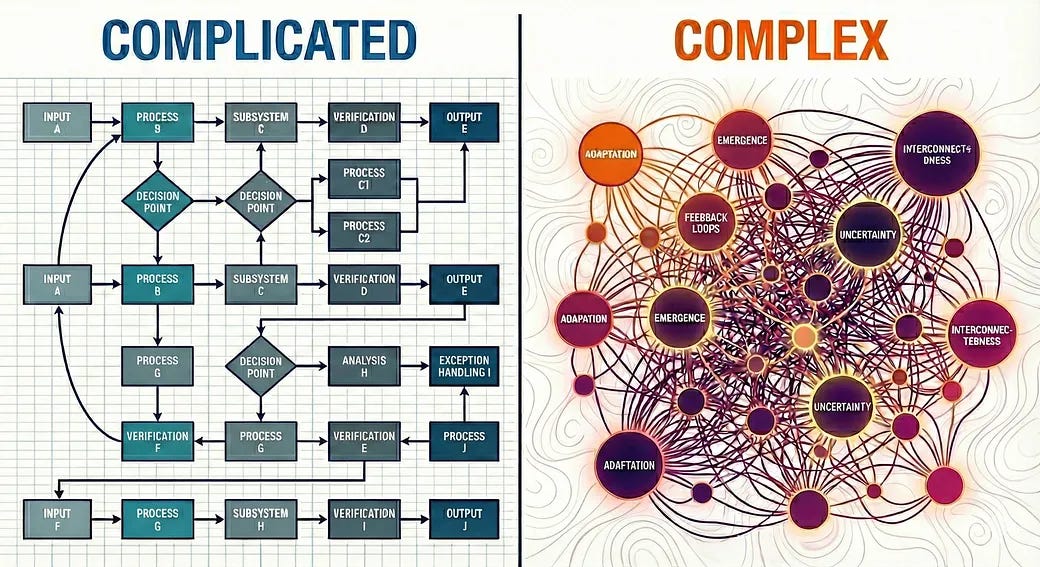
If schools were complicated machines, then what worked in my school in Taiwan, in Beijing, or in Denver should work in my school in Jordan. Machines are predictable like that.
However, schools are not really like very much like machines. They are much more like complex ecosystems. What works for designing a regenerative farm in Nebraska is not the same as what works for designing a regenerative farm in Georgia. The climate, the aquifers, the local insects and birds, the microbiome, the soil composition– all of these aspects are different enough that you can’t use exactly the same mechanisms from one farm to the next. Context is key to mutual flourishing.

Ida Rose Florez, in her recent book The End of Education as We Know It, goes so far as to assert that “the root problem with schools today is their tenacious fixation on complicated, reductionist, machine-based thinking.”1
Florez’s point is important for me as a new leader to keep in mind. My new school is not a machine with easily diagnosed problems. I love efficiency, I love solving problems and moving forward. This bias toward action is part of why I became a leader. It’s tempting for me to jump too quickly to confident action based on what worked in the past, but that is reductionist, machine-based thinking, and it never works.
In fact, I’ve never seen a solution copied exactly from one context to another that works as intended. Whether it’s leaders who come into a new school fixated on a particular program they want to implement, or teachers who are handed an overly scripted curriculum that they’re supposed to deliver word-for-word, these “solutions” end up causing more problems than they solve. Like H.L. Menken said, “For every complex problem there is an answer that is clear, simple and wrong.”
So what is the way forward? As I suggested at the beginning, the best leaders I ever worked alongside started their tenures in schools with a whole lot of humble listening. I remember one supervisor who spent almost a full year asking questions about the history behind each program, policy, and process. When she did take action to make substantive changes in our school, she did so from a place of deep, nuanced understanding. I hope to emulate her: balancing my bias toward action with real inquiry.
Michael Watkins discusses this in his book, The First 90 Days:2
“Effective leaders strike the right balance between doing (making things happen) and being (observing and reflecting). Planning to learn means figuring out in advance what the important questions are and how you can best answer them. If you do not focus on learning, you can easily make poor decisions.”
After rereading this book, I wrote myself a transition plan, delineating all the ways I’ll focus on building relationships and learning this context over the next few months. This entry plan includes:
Walking through all classrooms multiple times in the first month to understand teaching and learning.
One-on-one meetings with each person in my section to learn about the school through their eyes.
Spending time in recess and lunch getting to know students.
Planning parent meetings and “tea with the principal” during parent/teacher conferences.
Here are some phrases I’m trying to reach for to help me in my learning journey:
“Help me understand the thinking behind this.”
“Tell me more.”
“What might I be missing?”
These questions have a kind of magic power, opening up vistas for understanding to emerge.
It takes a lot of intentionality and more than a little courage to come into a new school and ask these kinds of questions over and over, foregoing certainty for curiosity.
But just as ecosystems flourish when given the care and deep attention they deserve on regenerative farms, we humans flourish in interwoven communities of care and curiosity. Regenerative leadership requires nothing less.
Florez, Ida Rose. The End of Education as We Know It: Regenerative Learning for Complex Times. New Society Publishers, 2025.
Watkins, Michael. The First 90 Days: Proven Strategies for Getting Up to Speed Faster and Smarter. Harvard Business Review Press, 2013.
That sounds so familiar! https://mindshiftingwithmitch.blog/2026/08/14/leading-complex-change-why-new-initiatives-fail-and-how-mindsets-must-shift-3/
Like the analogy. Rings true.